
Koh Chang Travel Guide · Chapter 3 of 8
Koh Chang by Season: Monsoon, High Season and What Closes
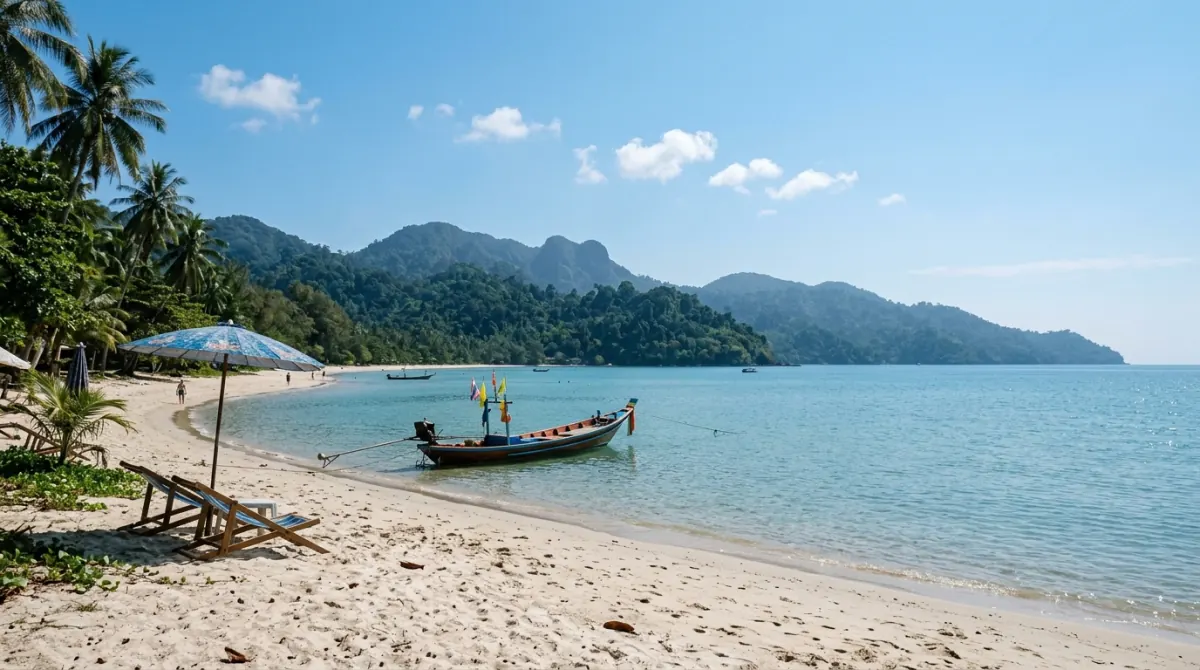
Koh Chang's high season is November to March — calm sea, every boat running, highest prices. From late May to October the rain arrives in a block and the island-hopping and snorkelling boats stop, though the mainland ferry keeps running. November is the best-value month of the year.
At a glance
| High season | November to March; busiest and dearest from late November to February |
| Peak within the peak | roughly 20 December to 5 January — book months ahead |
| Green (low) season | mid-to-late May to the end of October |
| Wettest block | June to September, each month averaging over 500 mm |
| Driest months | December to February |
| Hottest month | April, average daytime high 34.1°C |
| Coolest months | August and September, average high 31.5°C — the rain cools it, not the calendar |
| Sea temperature | 28–30.5°C all year; never cold enough to matter |
| Mainland ferry | runs year round — timetable and reliability record in Chapter 1 |
| Inter-island boats (Koh Wai, Koh Mak, Koh Kood) | suspended or cut back from roughly May to October; full service back from 1 November |
| Mu Ko Chang National Park | no annual closure season — the park stays open when the boats stop (Chapter 4) |
| Best single month | November |
Rain arrives in a four-month block, not spread evenly across the wet season
December, January and February are close to dry. June, July, August and September each average 500 mm or more. There is no long, moderate drizzle season in between — the pattern is a hard switch in May and another one in late October.
| Month | Rainfall | Sea state | Crowds | Room prices | Boats |
|---|---|---|---|---|---|
| January | 20 mm | Calm | Busy | Peak | All running |
| February | 35 mm | Calm | Busy | Peak | All running |
| March | 70 mm | Calm, getting hot | Busy, tailing off | High | All running |
| April | 125 mm | Calm; evening thunderstorms | Quiet except Songkran | Falling after mid-month | Winding down from late April |
| May | 395 mm | Turns choppy from mid-month | Quiet | Low | Inter-island boats stop |
| June | 515 mm | Choppy, rough spells | Very quiet | Low | Most suspended |
| July | 485 mm | Choppy, rough spells | Very quiet | Low | Most suspended |
| August | 495 mm | Roughest; Gulf swell to 3 m | Very quiet, Thai holiday spike | Low | Most suspended |
| September | 500 mm | Roughest; Gulf swell to 3 m | Emptiest month | Lowest | Most suspended |
| October | 300 mm | Easing through the month | Quiet | Low | Some services back from 1 October |
| November | 55 mm | Calm returns | Busy but not peak | High-season rates from 1 November | All running |
| December | 7 mm | Calm | Peak from mid-month | Peak plus a festive premium | All running |
Two things about that rainfall column. First, the figures are monthly averages from one dataset; a second widely used dataset gives materially different numbers for the same island — 623 mm for July as the wettest month against 515 mm for June here, and 20 mm for December against 7 mm. Both agree the wet block is June to September and that December is the driest month, so treat the block as solid and any single month's figure as approximate. One long-running local guide names September as the wettest month, which matches neither dataset exactly but does match the sunshine and rain-probability numbers: September has the year's highest chance of rain and under two hours of sunshine a day.
Second, 500 mm in a month does not mean 30 days of grey. Rain on Koh Chang in the wet season usually falls as heavy localised showers or an overnight downpour, and it is possible to be in sunshine at Klong Prao while it is hammering down at Kai Bae two kilometres away. The problem with the wet season is not that you get no beach days. It is that you cannot plan which days they will be, and the boats that need a settled forecast do not run.
The sea-state column describes the prevailing monsoon pattern rather than any given week. November to February is the northeast monsoon — the calmest water of the year. March and April are the hot season, still calm, with thunderstorms that mostly arrive in the evening. The southwest monsoon runs from about mid-to-late May to the end of October, when the sea off the west coast is choppy most of the time and the Gulf can produce swell up to three metres in the late-August to late-September window.
High season buys you calm water and open boats, not a better beach
What the high-season premium buys is everything that needs a settled sea. Inter-island boats run to Koh Wai, Koh Mak and Koh Kood on a full timetable. Snorkelling day trips to the Koh Rang group go out daily rather than being cancelled at 07:00. Dive visibility is at its annual best, averaging 10 to 15 metres — Chapter 4 has how that compares with the Andaman and what it means site by site. The full range of restaurants, bars and tour desks is trading. And the sea is calm enough that a rough day is the exception rather than the default.
One distinction is worth holding on to, because it decides whether April works for you. November to March is the tourism high season — the one that sets room rates and crowd levels, and the one this chapter means by the term throughout. The boats keep a different calendar: the operators' own high season runs 1 November to 30 April (Chapter 4), which is why April can be quiet on the beach, softening in price and still fully served on the water.
The costs are equally concrete. Room rates are at their annual highest, and the Christmas-to-New-Year fortnight sits above even that; properties routinely price that period separately from the rest of high season. Rooms in the good beachfront places on the popular beaches go months in advance for that fortnight. And through the November-to-February window several of the west coast beaches have very little dry sand in the middle of the day, for the tide reason in the note above.
March is the quiet half of high season: the crowds thin, the sea is still calm, the boats are all still running and rates begin to soften before Songkran. It gets hot — April is the hottest month of the year at an average high of 34.1°C, and March is not far behind.
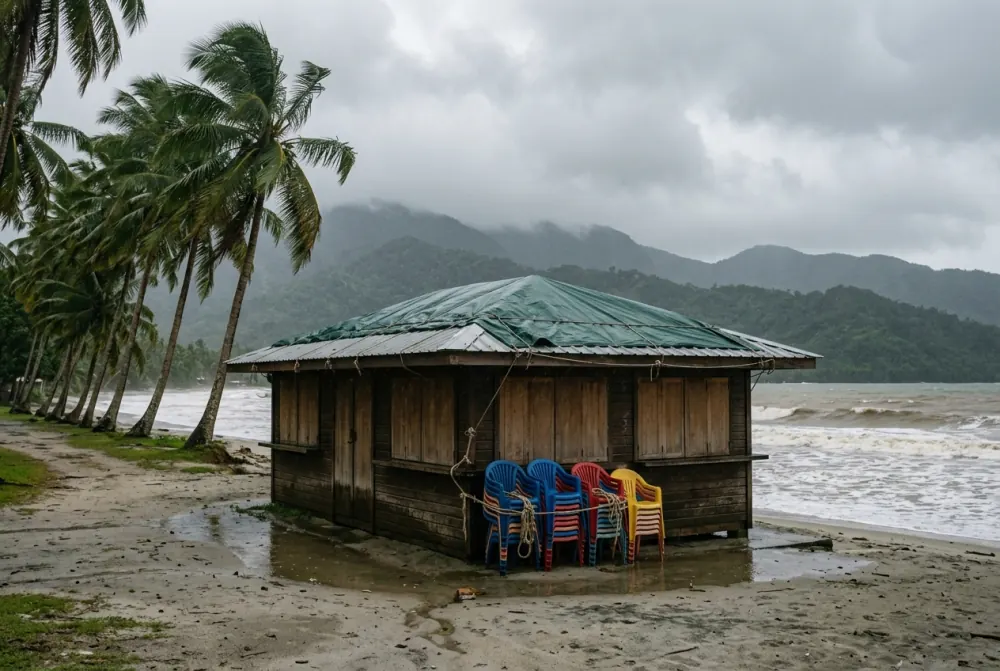
What actually shuts from May to October is the boat network
The dates below are the ones the operators themselves published for the 2026 season.
Inter-island boats. The Kai Bae Huts speedboat to Koh Wai, Koh Mak and Koh Kood does not run from 1 May to 31 October. Koh Chang Express, the wooden-boat service out of Bang Bao, does not run from 1 June to 30 September. The Boonsiri catamaran is the only year-round link and even that drops to a single daily sailing at 13:00 for the same June-to-September window. Wooden-boat and speedboat services generally stop at the end of April or in early May depending on weather and demand. Day trips to Koh Wai stop for the rainy season entirely.
Snorkelling day trips. Permpoon Sub published a closure from 16 May 2026 to early November. Kai Bae Huts lists its speedboat trips as closed in the rainy season, May to October. The two big operators, Thaifun and Sattra Tours, keep selling through the low season but describe the trips as weather dependent — which in practice means a morning call on whether the boat goes.
What stays open. The mainland ferry runs to its normal schedule year round. Dive shops largely keep trading and dive boats go out daily when conditions allow, because there are sheltered moorings on the east and north sides. The waterfalls are at their best from October to late December, when every fall has water in it — the smaller ones dry to a trickle from February onwards (Chapter 5). Lonely Beach's bars run through the low season. Room rates on the island drop by something like 30 to 50 per cent.
The marine park. Mu Ko Chang has no annual closure season, so what stops here in the wet months is the boats rather than a park order — Chapter 4 has the park's status, the island-by-island picture and what to ask your operator when you book.
What is unclear. Sources contradict each other on how much of the island's food and accommodation actually closes. One long-running local guide states that most restaurants, bars and shops stay open through the wet season. Others say that many beachside facilities close and that a lot of businesses wind down over the six months. No source reports this business by business. The safest reading is that it varies by beach: the developed west coast strip keeps trading, the more marginal beachfront operations do not. So in low season book where the strip is walkable and a 7-Eleven backs it up — White Sand Beach, Kai Bae or Lonely Beach village (Chapter 7 has the shop map) — and do not book somewhere that leaves you depending on a single kitchen, which is the risk at spread-out Klong Prao, at Bailan, at Bang Bao and on the east coast. What is not in doubt is that resorts on Koh Mak and Koh Kood do shut for the rainy season, so a low-season trip that assumed an onward island stop needs checking first.
Getting around, and getting help. Neither of these has a published seasonal answer, and both are worth planning around. On transport, the island's songthaew timetable is published as a single year-round service with no low-season variation, and no source says whether trucks run less often or wait longer to fill when the island is empty — assume longer waits in September than in February, and be ready to pay for a whole vehicle, agreeing the price in baht before you get in (Chapter 6 has the fares and why the charter rate is not published). On safety, lifeguard cover is occasional at best, and no source says whether any of it is maintained from May to October — the months with the worst rip currents. Until that is settled, plan a low-season beach trip on the assumption that nobody is watching the water.
The ferry almost never stops; the last sailing is what threatens your flight home
The crossing's reliability record is in Chapter 1, along with the timetable and the road times. The seasonal footnote to it is the one documented precedent found for a full stoppage: a Bangkok Post report of ferries and marine tours halted at Koh Chang after torrential rain, rough seas and flooding. Search metadata dates it to September 2019 — the deepest month of the wet season — but the article body sits behind a paywall, so neither the date nor how long the stoppage lasted could be confirmed.
So the realistic risk to your flight home is not that the sea stops the boat. It is that the last sailing leaves at 18:30 with nothing behind it, and that the road to Bangkok starts after that.
The wrinkle that belongs to the low season is the wait. Since a fuel conservation order reported from April 2026, sailings other than the first and last of the day leave only when the boat is full. In the high season that is barely noticeable — boats fill in twenty minutes. In the deep low season, on a wet Tuesday in September, it can mean a real wait at the pier for a boat that is not going anywhere until it has enough vehicles on it. And if the weather does close the crossing for a few hours, that wait lands on top of it.
Do not leave the island on the afternoon of your flight
In the low season, do not put the ferry and your flight on the same day. Take a morning boat and accept a long day, or better, leave the island the day before and sleep at Laem Ngop, in Trat town or in Bangkok — Chapter 1 has the sailing times, the road times and the mainland overnight options.
The reason to be firm about it is what a miss costs. If a ferry wait puts you at the airport after your flight has closed, you are a no-show: airlines do not rebook a no-show as a courtesy, so you buy a new ticket at the fare available that day, and on an international departure in high season that is the most expensive night of your trip. Travel insurance is unlikely to catch you either. Travel-delay and missed-departure cover is normally written around a delay to a scheduled carrier you hold a ticket with, over a stated minimum number of hours, evidenced by a letter from that carrier. A queue at a vehicle ferry you bought a walk-on ticket for at the window, or a car you arranged yourself, does not usually produce that document.
A dawn flight is the hardest case. Even the last boat plus the drive puts you into Bangkok around midnight at the earliest, with nothing behind it if either half slips — and that is arithmetic from the published sailing and drive times, not a logged run. For a departure before about 09:00, sleep on the mainland the night before.
November is the value month; October and April are the calculated gambles
November. The strongest recommendation in this chapter. Rainfall has collapsed from September's 500 mm to around 55 mm. The sea is calm again. The inter-island boats are back on 1 November and the snorkelling operators early in the month, so the full range of trips is available. And the peak-season crowds and the festive premium do not arrive until well into December. Local guides call it the best month to visit the island and the reasoning holds up.
The second half of October. A real bargain if you can take the risk. Rain is down to about 300 mm and easing through the month, room rates are still at low-season levels, and some boat services return from 1 October — Koh Chang Express and the full Boonsiri schedule both come back at the start of the month. What you do not get is the snorkelling day trips, which mostly stay shut until early November, or the Kai Bae inter-island speedboat, which is off until 31 October. October is a good month for a cheap beach-and-waterfall week and a poor one for a boat-based trip.
April. Hot, dry-ish at 125 mm, and thinning out. The boats are still running until the end of the month, rates come down after Songkran, and the sea is still calm. The trade is heat — 34.1°C average highs, the year's hottest — and the mid-month Songkran shutdown of normal life. Late April is the sweet spot: post-Songkran, pre-monsoon, boats still going.
Early May looks like a natural extension of April and is not. Rainfall jumps to nearly 400 mm on the monthly average, the inter-island speedboat stops on 1 May, wooden-boat services stop around the same time, and the main snorkelling operator's published closure starts on 16 May. May is the month the season ends, not a shoulder month.
Songkran and New Year fill the vehicle queue, and Thai long weekends fill the island
Koh Chang is within a comfortable drive of Bangkok, which makes it a domestic weekend destination as much as an international one. That shapes the crowd calendar in a way that is invisible if you only look at the foreign high season.
The two dates that matter most are Songkran, 13 to 15 April, and the New Year holiday around 31 December and 1 January. Both fill the island, both fill the ferry, and both are frequently extended by additional government-declared days that change from year to year — check the official holiday calendar for your travel year rather than assuming three days for Songkran.
Beyond those, the fixed-date public holidays that reliably produce long weekends are 6 April (Chakri Day), 1 May (Labour Day), 12 August (the Queen Mother's birthday and Mother's Day), 13 October (King Bhumibol Memorial Day), 23 October (Chulalongkorn Day), 5 December (the late King's birthday and Father's Day) and 10 December (Constitution Day). The Buddhist holidays — Makha Bucha, Visakha Bucha and Asalha Bucha — move with the lunar calendar and can land anywhere from February to July. When any of these falls next to a weekend, Thai visitors arrive by car, and the east coast and Salak Phet places that cater mainly to Thai weekenders fill up along with the west coast.
The pinch point is the vehicle queue at the mainland pier, for which no source publishes a holiday length or waiting time. What matters more is that the queue is a queue of cars. A walk-on passenger buys a ticket at the window and boards; the vehicles are the constraint on how quickly the boat fills and how many trips it takes to clear the backlog. So at a holiday peak, cross on foot — which is what the mainland transfer leaves you doing anyway, since it ends at the pier. The car is the thing that waits, not you.
Frequently asked questions
When is the best time to visit Koh Chang?
November, if you want one month. Rainfall has dropped to around 55 mm, the sea is calm, and the boat network is back — inter-island services from 1 November, the snorkelling operators early in the month — but the peak-season crowds and the Christmas price premium have not arrived yet. December to February is more reliably dry and more expensive; March is a good quieter alternative with the boats still running.
Is Koh Chang worth visiting in the low season?
Koh Chang is worth a low-season trip for a beach, waterfall and food week, and not worth one for a boat trip. From May to October the waterfalls are full, room rates drop by roughly a third to a half, dive boats still go out from sheltered moorings, and the island is quiet. But most snorkelling and island-hopping services suspend, so if Koh Rang, Koh Wai or Koh Kood is the point of the trip, go between November and April.
Do the ferries stop running in bad weather?
The Koh Chang ferries stop for weather only rarely — Chapter 1 has the reliability record and the timetable. The seasonal constraint is not the weather but the clock and the wait: the last sailing is 18:30 with nothing behind it, and in the empty months the boats between the first and last of the day only leave when they are full.
What closes on Koh Chang in the rainy season?
The boat network, with dates. The Kai Bae Huts inter-island speedboat stops 1 May to 31 October, Koh Chang Express 1 June to 30 September, and the Boonsiri catamaran drops to one daily sailing over the same period. Snorkelling operators either close outright from mid-May or run weather dependent. Sources disagree on how much of the food and accommodation closes, so book a beach with a walkable strip behind it — White Sand Beach, Kai Bae or Lonely Beach village — rather than a place where one kitchen is the only kitchen.
Does Koh Rang marine park close for the monsoon?
Koh Rang's marine park has no closing season, so what stops in the wet months is the boats rather than the park — Chapter 4 has the park's status, which islands you can actually be taken to and what to ask your operator.
How bad is Songkran on Koh Chang?
Busy, wet in every sense, and slow at the pier. Songkran is 13 to 15 April with extra government days added in most years, and it fills the island with Thai visitors arriving by car. Expect long vehicle queues at the mainland pier and book accommodation well ahead. Walk-on passengers are far less affected than drivers.
Keep reading
- Travelling in the monsoon or over a Thai holiday, when the road to the coast and the queue at the pier are least predictable: book a private transfer to the pier
Last updated: 2026-08-29. Ferry and pier notes come from Smile Taxi Service drivers running Bangkok-Trat transfers.