
Koh Chang Travel Guide · Chapter 2 of 8
Which Koh Chang Beach Is Right for You
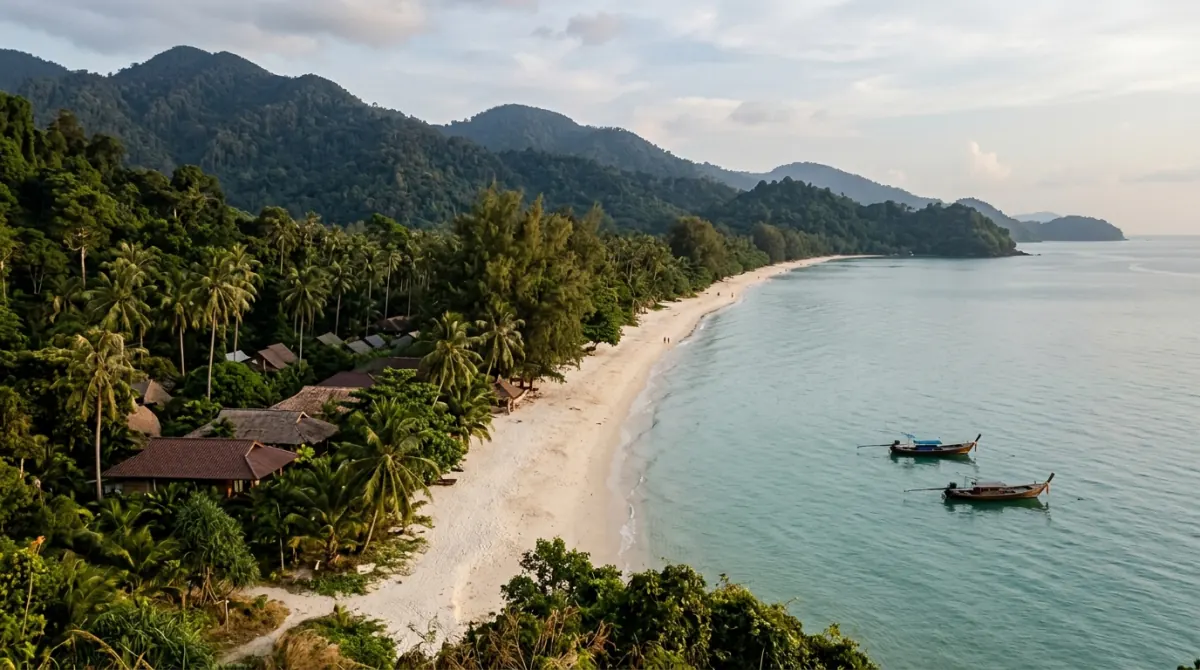
Koh Chang's main beaches run down one west-coast road. White Sand is busiest, Klong Prao longest and most resort-heavy, Kai Bae the family default, Lonely Beach the party end, and Bang Bao a pier village with no beach at all. Book near the north end of whichever bay you pick — the water is deeper there.
At a glance
| Area (north to south) | What it actually is | Sand and swimming | Price level |
|---|---|---|---|
| White Sand (Hat Sai Khao) | The busiest strip on the island: a kilometre of bars, minimarts, dive offices and tour desks behind the sand | Among the island's best at the northern end; gives way to rocks and cliff at the southern end | Budget to high |
| Chai Chet | A small headland area between White Sand and Klong Prao, usually counted separately | Short, but the adjoining north end of Klong Prao bay has the deepest water on that whole stretch | Budget to high |
| Klong Prao | The longest beach area, over 3 km, cut into three sections by two canals; most of the island's large resorts | The shallowest of the main beaches, with rocks in the central section | Mid to high |
| Kai Bae | Slightly cramped and dusty, well priced, busy without being a party beach | Very shallow at low tide; rocky in the middle; swimming best at the two ends | Budget to high |
| Lonely Beach (Hat Tha Nam) | The backpacker and party centre: a short beach plus an inland village of bars | A short strip, and most rooms sit back from it rather than on it | Budget |
| Bailan | The quiet, low-key neighbour immediately south of Lonely Beach | Red sand and stones. Not a swimming bay | Budget to mid |
| Bang Bao | A stilt fishing village and pier; the island's boat-tour and dive departure point | No beach | Budget to mid |
| East coast (Salak Kok, Salak Phet) | Working fishing and fruit-farming villages, almost no tourism infrastructure | No beach at either. Long Beach in the far south-east is the exception | Budget to high — quiet rather than cheap |
Price level is a signal of what kind of place each beach is, not a quote: it says where the bulk of the rooms sit, and almost every beach has something cheaper and something dearer than its band. Chapter 7 has the bands in baht, by beach, budget tier and season.
Five beaches on one road, with less in common than the photographs suggest
The developed side of Koh Chang is a single road down the west coast. The ferry lands on the north-east corner (Chapter 1 covers the crossing), and everything most visitors come for sits on the opposite side of the mountain. The beaches are strung along that one road in a fixed order, and the difference between two of them twenty minutes apart is the difference between a nightly beach party and a resort with a pool villa.
White Sand Beach (Hat Sai Khao)
The most developed and busiest beach on Koh Chang, and the one most first-time visitors default to. That is a reasonable default. It has the most restaurants, the most shops, several 7-Elevens, a bank, the island's private hospital and the widest choice of rooms, from fan rooms to oceanside villas. One long-running local guide describes the strip behind the beach as a kilometre of concrete with no redeeming architectural features, which is fair. You come here for convenience and for the sand, not for the setting.
The beach itself is one of the island's best at its northern end, and it deteriorates as you walk south, giving way to rocks and then cliff. If you book at White Sand, book at the north end. The southern end is cheaper for a reason.
Chai Chet
A small area on the headland between White Sand and Klong Prao, usually listed separately by local guides. It has a handful of resorts and little else, and its main practical relevance is that the water at the Chai Chet end of Klong Prao bay is the deepest and best for swimming on that whole 3 km stretch.
Klong Prao
The longest beach area on the island — a curving bay of more than 3 km, split into three sections by two canals — klong means canal. It holds the highest concentration of large resorts on Koh Chang: the southern section has the cluster of upmarket properties, the northern section more three-star package hotels. Rooms run from cheap fan rooms to pool villas at the top of the island's range.
Klong Prao is spread out and quiet in a way White Sand is not. That cuts both ways. There is no strip, so you are dependent on your resort's restaurant or a ride to somewhere else for dinner, and the walk between the northern and southern sections is long enough that most people do not do it twice. The swimming is covered below and it is the one real weakness.
Kai Bae
Kai Bae has become perhaps the island's most popular area for families and independent travellers, and it earns that on price and atmosphere rather than on the beach. The strip is a little cramped and dusty, the rooms are well priced, there is a good restaurant scene, and the evening has bars without having a party. It sits squarely between White Sand's commercialism and Lonely Beach's noise, which is exactly why it works for a lot of people. Rooms start at the budget end and run up to pool villas and suites among the most expensive on the island.
The beach is split into two halves. Swimming is decent at the northern and southern ends. The central section, in front of the more expensive resorts, is rockier and the sand there tends to disappear at high tide.
Lonely Beach (Hat Tha Nam)
The backpacker hub and the party centre. Lonely Beach is really two places: a short beach, and an inland village a few minutes back from it with a Khao San Road feel — reggae bars, DJs, some live music, tattoo shops. Ting Tong, Himmel and X Bar are the venues people name. Beach parties run year round, not just in high season. It is also the cheapest place to sleep on the island — the island's dorm floor is here — though there are pool villas at the quieter edges too.
Two things to know before booking. Most accommodation is set back from the sand rather than on it, so "Lonely Beach" in a listing often means the village, not the beachfront. And the noise in the central village at night is serious — local guides warn about it specifically. If you are here for the bars that is the point; if you booked Lonely Beach because it sounded peaceful, the name has misled you.
Bailan and Klong Kloi
Bailan sits immediately south of Lonely Beach and is its quiet opposite: low-key, few businesses, and a bay that is mainly red sand and stones rather than beach sand. It is not somewhere to swim. One resort there has built an artificial beach to work around the problem, which tells you what the natural one is like. Booking sites routinely sell Bailan as a beach destination. It is not one.
Klong Kloi, sometimes listed as Bang Bao Beach, is the last real sand before the road runs out at the south-west tip, a couple of kilometres past Bang Bao. It is quiet and it is a real beach. It also has no ATM, and it is the furthest point on the island from everything else. Watch the name when you book: "Bang Bao Beach" is used in listings both for Klong Kloi and for Hat Sai Noi, the nearer strip just south of the pier, and the two are a couple of kilometres apart. Check the map pin, not the name.
Bang Bao is a pier, not a beach
Booking sites still sell rooms at Bang Bao to people who assume there is sand; local guides list the lack of an immediate beach as its main drawback. The nearest sand is Hat Sai Noi, and then Klong Kloi a couple of kilometres further south.
What Bang Bao is instead is a former fishing village built on stilts over the water, now the island's boat hub. Tourism has replaced fishing as the main income. The pier has been extended with a concrete jetty and a lighthouse at the end, and the central walking pier is lined with shops, dive offices and seafood restaurants built out over the sea. Eating there costs more than the equivalent meal elsewhere on the island. Rooms are cheap by island standards, up to mid-range for a two-room cottage. Chapter 7 names the restaurants and covers how to order fish sold by weight without a surprise at the end.
The other thing Bang Bao is: the departure point for almost every boat trip on the island. Snorkelling boats to the Koh Rang group, dive boats, and the inter-island services to Koh Wai, Koh Mak and Koh Kood all leave from here. That matters to your beach choice in one concrete way — trips collect you from your resort in a ladder down the coast, so the further north you sleep, the earlier your day starts. Chapter 4 has the pickup times and the trips themselves.
Staying at Bang Bao makes sense if you are diving most days and want to walk to the boat. If you are not, you have chosen the one place on the west coast where you cannot go for a swim.
The east coast is empty for three practical reasons, not because it is a secret
First, there is no accessible beach. Salak Kok is a fishing community of around twenty houses on a mangrove bay and has no beach at all. Salak Phet, a rural community of fruit farmers and fishermen in the remote south-east, has none either. The one exception is Long Beach (Ao Yai) in the far south-east, which has real sand and deep water and only a couple of places to stay.
Second, you are stranded without your own transport. The shared songthaew service to Salak Phet is infrequent and may have been discontinued altogether — sources disagree, and Chapter 6 sets out both positions and what to budget instead. There is no walking to anything, no passing traffic to flag down, and no evening service.
Third, the infrastructure simply is not there. No nightlife, very few restaurants, and no shops, ATMs or convenience stores on that side of the island (Chapter 7 maps what is where). Draw cash on the west coast before you go.
There is also a structural reason the east stays quiet: there is no loop road, so any trip to one coast has to be retraced (Chapter 6 has the southern gap and why nothing has been built across it).
None of which means the east coast is not worth a day. Salak Kok has a community-run kayak station where you paddle yourself along numbered markers through mangrove canals, an 800 m concrete mangrove walkway with a four-storey viewing platform, and a village-run seafood restaurant over the water. Salak Phet has a large seafood restaurant popular with Thai visitors, best avoided at midday and at weekends when tour groups fill it. Go for the day, sleep on the west coast — and go with your own transport, or with a driver who has agreed to wait.
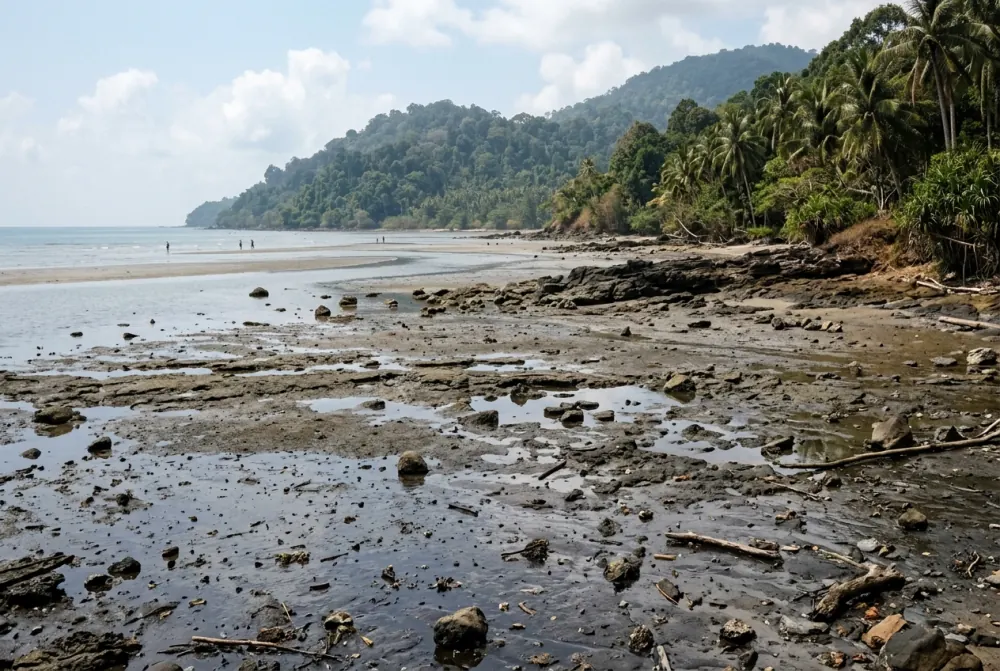
The tide decides whether you can swim
Local guides describe Koh Chang as running a single daily tide cycle — one high and one low a day, rather than the two of each most Thai coasts get. No tide authority corroborates that, so treat it as the local account rather than a settled fact, and check a Trat tide table against your own dates before you plan a day around it. What is not in dispute is that the daily swing is big enough to decide whether a given beach is swimmable at a given hour, and that is the complaint that ruins Koh Chang trips.
The timing is seasonal, and it inverts the usual advice:
- November to February. High tides tend to fall in the middle of the day. Good for swimming, but many beaches have very little dry sand during daylight hours.
- March to July. Low tides fall during the day. Wide beaches, but the sea is a long way out and shallow when you reach it. In the very low tides of May, June and July, enough seabed is exposed off Kai Bae to walk out to the islet of Koh Man Nai.
So the two seasons fail in opposite directions: in January you may struggle to find a towel-sized patch of sand at 2pm, and in June you may have half a kilometre of it and nowhere to swim.
The standing local rule that follows is worth more than any beach ranking: on White Sand, Klong Prao, Kai Bae and Lonely Beach, the sand is wider and the water deeper at the northern end of each bay. If swimming matters to you, book near the north end of whichever beach you choose.
Where the water is poor:
- Klong Prao is the shallowest of the main west coast beaches. Even at high tide it is hard to reach swimming depth — reportedly waist-deep about 20 m out. At low tide the sea recedes a long way. There are sharp rocks in the water in the central section, large stones near the tree-lined shore, and piled stones in front of some bungalows. The exception is the Chai Chet end, where the water is deeper and which is the best swimming spot on the bay.
- Kai Bae goes extremely shallow at low tide. You can walk roughly 100 m out with the water still below knee height. Fine for small children paddling; not a swimming beach at that state of tide. The central section in front of the upscale resorts is the rocky part.
- Bailan is red sand and stones and is not a swimming bay at any tide.
- Bang Bao has no beach, as above.
- White Sand's southern end turns to rock and cliff. The northern end does not.
No source sets out the low-tide behaviour of Lonely Beach, Klong Kloi or Bang Bao Beach. The shallow-and-rocky problem is documented for Klong Prao and Kai Bae, and Bailan is stony at any state of tide. For the southern beaches only the north-end-is-deeper rule applies, so treat their swimming as unknown until you can stand on the sand and look at it.
You will not be walking between these beaches
The beaches are separate settlements on a single road, and the road between them is a working highway that climbs away from the sea over headlands, with no footpath, no lighting outside the built-up strips, and heavily laden trucks on it. Two stretches of it are steep and hairpinned enough to be neither a walk nor a beginner's scooter ride — Chapter 6 names them and sets out why they account for most of the island's crashes.
What this means in practice:
- Within one beach, walking works. White Sand's strip, Kai Bae's strip and Lonely Beach's village are all walkable end to end. That is the case for choosing a developed beach if you do not want to ride.
- Between beaches, it does not. Every trip to another beach, to a restaurant you read about, or to the pier is a songthaew ride or a scooter. Budget for that in both money and hassle, not just time.
- Even inside Klong Prao, distance bites. The bay is over 3 km end to end and split by two canals. Booking "Klong Prao" tells you almost nothing about what you can reach on foot.
- Bang Bao and Klong Kloi are the far end of everything. Convenient if you are on a boat every morning, inconvenient for anything else.
If you do not intend to ride a scooter, this is the single strongest argument for White Sand or Kai Bae over the southern beaches: more of what you need is within walking distance of your room.
Match the beach to the trip, not to the photograph
| You are | Book | Swimming there | Why | Avoid |
|---|---|---|---|---|
| A family with young children | Kai Bae, or the northern section of Klong Prao | Paddling only | Kai Bae has well-priced rooms, restaurants, minimarts and a beach that goes shallow a long way out — poor for swimming, good for paddling. Klong Prao north gives you resort facilities and space | Lonely Beach. Bang Bao and Bailan, which have no usable beach |
| A couple wanting a resort and a pool | Southern Klong Prao | Poor — use the pool | The island's cluster of upmarket resorts and pool villas, spread out and quiet. Accept that you will ride out for dinner, and that this is the shallowest of the main beaches | White Sand's central strip, if quiet matters |
| A couple on a mid-range budget | Northern White Sand, or Kai Bae | Good at White Sand north; shallow at Kai Bae | Best sand on the island at the north end of White Sand, with everything else in walking distance. Kai Bae for the same at a lower price with a better restaurant scene | Southern White Sand, where the beach turns to rock |
| Backpackers and people who want a night out | Lonely Beach | Undocumented — see the tide section | The cheapest beds on the island, the bars, and beach parties year round rather than seasonally | Klong Prao and the east coast, where nothing is within walking distance |
| Divers | Bang Bao if you are diving most days; otherwise Kai Bae or Klong Prao | None at Bang Bao | Bang Bao is where the boats and most dive shops are, and you walk to them. Everywhere else you are collected from your resort in the morning | Bang Bao if you also want to swim, sunbathe or have a beach day between dives |
| People who want nothing to happen | Klong Kloi, or a day-tripper's version — sleep on the west coast, spend days at Salak Kok and Salak Phet | Undocumented at Klong Kloi; none on the east coast | Klong Kloi is real sand at the quiet end of the road. The east coast is quieter still but has no beach, no shops, and a shared songthaew service that is infrequent and may have been discontinued | Bailan, which is quiet but has stones instead of a swimming beach. Long Beach, unless sandflies do not bother you |
| First visit, short trip, no scooter | White Sand or Kai Bae | Good at White Sand north | Most services, most transport, most walkable, easiest to fix a mistake | The southern half of the island |
Frequently asked questions
What is the best beach on Koh Chang?
There is no single best one, but the northern end of White Sand Beach (Hat Sai Khao) has the best sand and water on the island, and it has the most restaurants, shops and services behind it. The trade-off is that it is also the busiest and most built-up area, and the southern end of the same beach turns to rock.
Where should I stay on Koh Chang for a family holiday?
Kai Bae is the most common family choice: well-priced rooms, a good restaurant scene, minimarts, and a beach that stays shallow a long way out, which suits small children paddling more than it suits adults swimming. The northern section of Klong Prao is the alternative if you want a larger resort with facilities and more space.
Which Koh Chang beaches are rocky or too shallow to swim?
Klong Prao is the shallowest of the main beaches, with sharp rocks in its central section, and it is hard to reach swimming depth even at high tide. Kai Bae goes extremely shallow at low tide and is rocky in the middle. Bailan is red sand and stones. Bang Bao has no beach at all.
Is Lonely Beach too noisy to sleep?
Lonely Beach's central village is too noisy to sleep in unless you are there for the bars. It is the island's party centre, with reggae bars and DJs running year round rather than seasonally, and local guides warn specifically about night noise. Most accommodation sits back from the sand in that village. Quieter options exist at the edges, but read the location before booking.
Does Bang Bao have a beach?
No. Bang Bao is a stilt fishing village and pier, and local guides list the lack of a beach as its main drawback. The nearest sand is Hat Sai Noi, then Klong Kloi a couple of kilometres further south. Stay at Bang Bao if you are diving or taking boat trips most days, not if you want a beach holiday.
Should I stay on the east coast of Koh Chang?
Koh Chang's east coast is not somewhere to stay. Salak Kok and Salak Phet have no beach, the shared songthaew service is infrequent and may have been discontinued (Chapter 6 has both published positions), and there are no shops, ATMs or convenience stores on that side of the island. There is also no loop road, so every trip has to be retraced. Visit for a day of kayaking and village seafood, and sleep on the west coast.
Keep reading
- Once you have picked a beach, the mainland leg is the part worth locking in early — book a private transfer to the ferry pier.
Last updated: 2026-08-29. Ferry and pier notes come from Smile Taxi Service drivers running Bangkok-Trat transfers.