
Koh Chang Travel Guide · Chapter 7 of 8
Eating, Sleeping and Practical Koh Chang
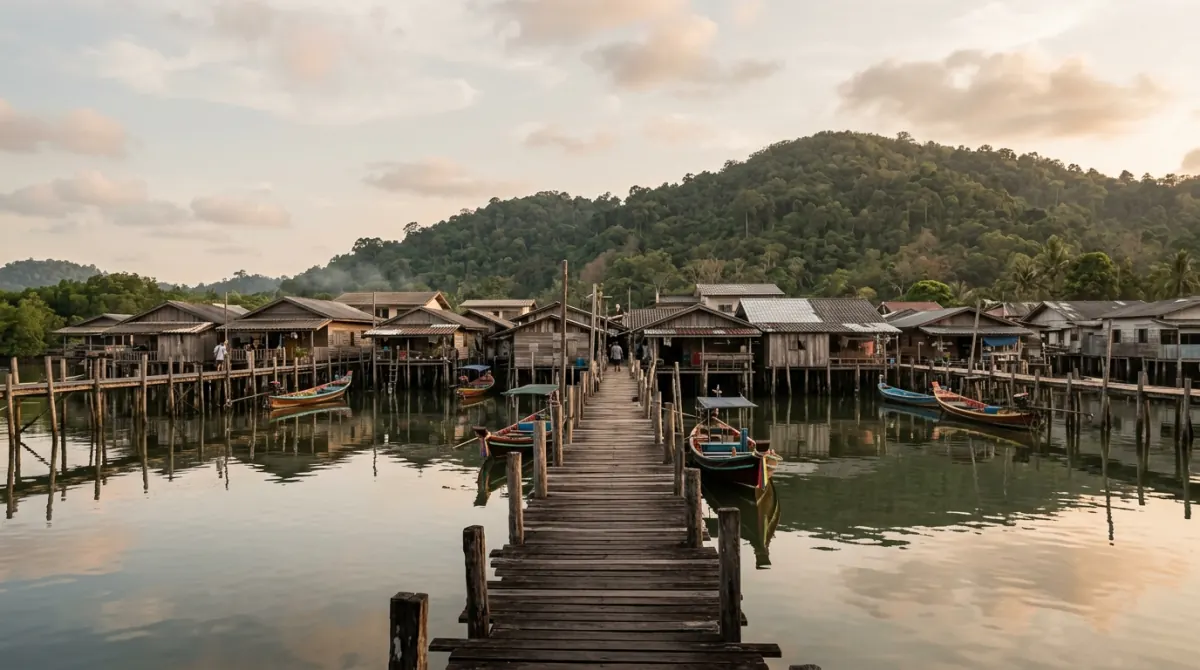
Koh Chang runs on cash — the ferry, songthaews and most kitchens take notes only, and there is no ATM at Klong Kloi, Salak Kok or Chek Bae. Rooms run from 300 THB a night to five figures and food from 40 THB a dish to 500 THB a head, with beach frontage carrying most of the markup.
At a glance
| Cash or card | A cash island. Resorts and larger restaurants take cards, often with a surcharge; ferry tickets, songthaews, small shops and most tour operators are cash only |
| ATM gaps | No ATM at Klong Kloi, Salak Kok or Chek Bae — draw cash before you head south-east |
| Foreign-card ATM fee | Around 220 THB (about US$7) per withdrawal, flat, on top of whatever your own bank charges |
| Last high-street bank branch | Krung Thai, White Sand Beach, 08:30–16:30 Monday to Friday |
| Mobile | 4G across the island, 5G on the developed west coast. AIS, True and DTAC (DTAC is now part of True) |
| Tourist SIM | From about 50 THB at 7-Eleven or a phone shop. Passport required to register |
| 24-hour hospital | Koh Chang International Hospital, White Sand Beach, +66 39 551 554 |
| Nearest full hospital | Bangkok Hospital Trat, on the mainland — reached by the island hospital's own medical boat, not the public ferry |
| Cheapest bed | Dorms from about 300 THB at Lonely Beach |
| Simple Thai meal | 40–70 THB for noodles or one dish over rice |
| Seafood, per head | About 300–400 THB at an ordinary island restaurant; 500 THB and up on Bang Bao pier |
| Main water hazard | Rip currents, worst May to October but possible any month after high winds |
| Most likely bite | Sandflies. Year round, not seasonal, and worst on quiet unraked sand |
Eating well here is mostly a question of knowing where the markup sits
Bang Bao charges for the pier rather than the fish
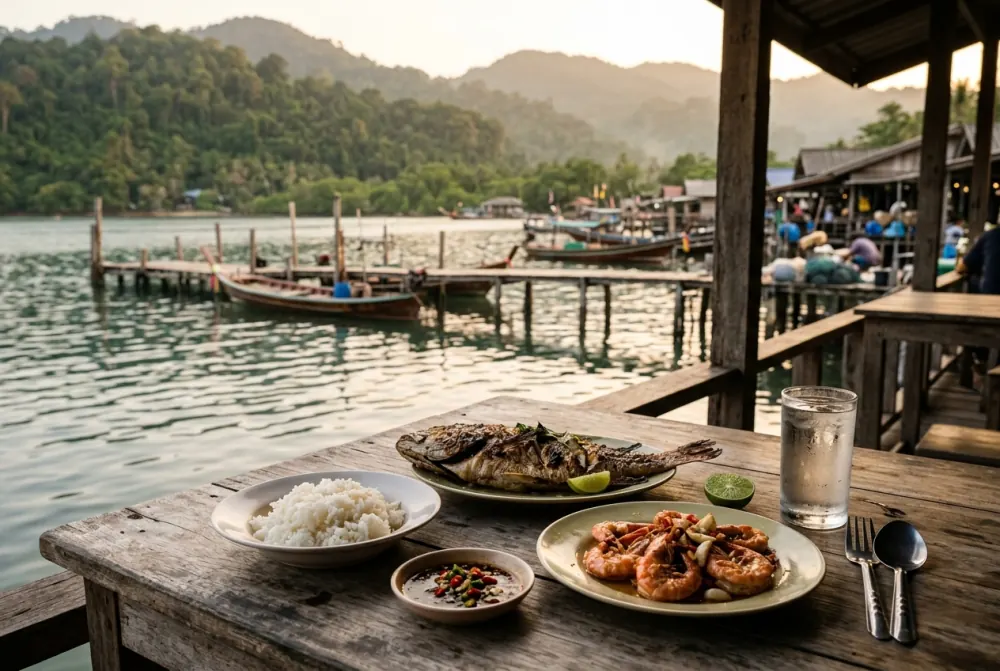
Bang Bao's stilt village is the island's boat-trip departure point, which is exactly why eating there costs more. Three seafood houses sit along the central walking pier — Ruan Thai Seafood, the first you reach and often the best rated; Chow Lay Seafood, long established, with an open kitchen and live tanks; and Nongyim Seafood, small, about eight tables on a terrace over the water. Budget 500 THB (about US$15) a head and up.
The reason is structural rather than dishonest. These restaurants have a captive audience of day-trippers and tour groups arriving by minibus and boat with nowhere else to eat within walking distance. Elsewhere on the island a shared seafood meal works out at roughly 300–400 THB per person before drinks, and a whole snapper runs about 200–350 THB depending on weight. Nobody publishes the size of the pier premium as a figure, but the gap between those two per-head numbers is the shape of it. That is a fair trade if you want to eat over the water after a boat day; it is money wasted if you were going to eat seafood anyway and could ride ten minutes up the road.
How to order fish without a surprise bill
Fish is sold by weight from tanks at the entrance, and menus quote two prices for two portion sizes rather than a single figure. Three things settle the bill before it arrives:
- Point at the fish, then ask for the weight and the total in baht before it leaves the tank. Not the per-kilo rate — the total.
- Agree the cooking method at the same time. Steamed with lime is the cheapest treatment and the one that shows whether the fish is fresh.
- Check whether rice is separate. Curries are commonly priced without it, at 100–150 THB depending on the beach.
No source publishes per-kilogram rates for the Bang Bao pier restaurants, and they move with the catch, so there is no benchmark figure to hold them to. Confirming the total in advance is the only protection available.
Salak Kok and Salak Phet, where the money stays in the village
Salak Kok, on the sheltered mangrove bay on the south-east coast, is a fishing community of around twenty houses that runs as a cooperative and shares tourism income among its members. Salakkok Seafood is the village restaurant, built over the water and supplied by families who land the fish themselves. Dishes run around 300 THB, so roughly 400–500 THB per person — not cheap, but the setting is a working mangrove bay rather than a tour-boat car park, and it is quieter than Bang Bao by a wide margin. Kayaks through the mangrove canals can be hired at the same spot.
Salak Phet, further round the same coast, has a large and well-known seafood restaurant popular with Thai visitors, with fish held in keep nets and views across the bay. Dishes are again around 300 THB. It fills with Thai tour groups around midday and at weekends, so go early or mid-afternoon.
Everyday eating is cheap; the sea frontage is the expensive part
The gap between a roadside kitchen and a beachfront restaurant on Koh Chang is wider than the gap between beaches. Noodles or one dish over rice cost 40–70 THB (about US$1.20–2). Thai dishes for sharing run 100–200 THB each. A small beer is 60–80 THB, a fruit shake 40–60 THB, and a decent cocktail starts around 180 THB. Western food carries the usual island markup: a basic burger from about 100 THB, a gastro-style one around 300 THB, a generic pizza 200–300 THB and a good one 250–350 THB. Drinkable wine starts around 900 THB a bottle, which tells you most of what you need to know about importing to an island.
The cheapest good eating is inland and roadside rather than on the sand. Named places that local guides return to include Nong Anat at Chai Chet for pre-cooked southern-style curries, Jae Kloi near Kerdmanee Resort, Took Ka Ta Kai Moon in Kai Bae for rotisserie chicken and Isaan dishes, and the small food court behind Morgan Restaurant in Kai Bae. Kai Bae also has Goong Ka Ta, an all-you-can-eat buffet just south of AWA Resort at 239 THB, which is one of the busiest restaurants on the island.
The night market question
A nightly street-food market is documented in the centre of White Sand Beach, roadside behind Apple Resort and Bamboo Resort — grilled meat on sticks, seafood, som tam, pad thai, plus fruit and smoothie stalls. It is priced for tourists rather than at mainland street-food rates, but it is still the cheapest hot food on that stretch.
Whether it is currently running is unclear. A local guide updated in August 2026 describes it as operating nightly; a 2026 visitor review states it no longer runs and that the cheapest alternative on the strip starts around 180 THB. No source publishes its hours. Treat it as a bonus if it is there rather than as the plan for your first evening, and have a fallback in mind.
7-Eleven density is a planning input
Convenience stores track the west-coast tourist strip and stop dead beyond it. Around nine 7-Elevens are listed on the island: four at White Sand Beach, two at Kai Bae, one at Klong Prao, one at Bang Bao and one at Klong Son. None on the east coast, none in the south-east. Lonely Beach has a mini-mart styled to look like a 7-Eleven but is not served by one, so anything beyond basics means riding to Klong Prao or White Sand. There is also a Big C at Pearl Beach, with the post office opposite it.
They matter more here than in a town because they are where you buy SIM cards, charging cables, adapters, water and repellent at a fixed price at midnight. If you are staying somewhere without one, do a stock-up run on your first afternoon.
What a room actually costs, beach by beach
Which beach suits you is settled in Which Koh Chang Beach Is Right for You. What each one costs is below. These are high-season rates in THB per night — the tourism high season runs November to March and is dearest from late November to February — and they exclude the Christmas and New Year fortnight, which is priced separately and higher everywhere.
| Area | Budget | Mid-range | Top end |
|---|---|---|---|
| White Sand Beach (north) | 700–900 | 1,750–8,500 | 4,800–11,500 |
| White Sand Beach (south) | 900–1,300 | 1,200–5,000 | 4,800–9,450 |
| Chai Chet | 450–2,850 | 1,400–4,600 | 5,985–14,600 |
| Klong Prao | 990–3,200 | 2,500–8,500 | 6,800–50,000 |
| Kai Bae | 1,000–2,500 | 2,500–6,000 | 3,870–64,000 |
| Lonely Beach | 300–3,500 | 2,000–5,000 | 3,300–9,750 |
| Bailan | 400–1,300 | 1,300–3,000 | 2,700–5,700 |
| Bang Bao village | 600–1,200 | 2,300–5,800 | — |
| Bang Bao Beach (Hat Sai Noi) | 450–1,800 | 2,600–5,500 | 4,500–10,000 |
| Pearl Beach | 450–1,100 | 1,200–2,700 | 7,800+ |
| Klong Son | 700–2,000 | 2,200–12,000 | 8,000–15,000 |
| East coast | 900–2,000 | 2,200–6,500 | 6,000–30,000 |
Three things the table shows. Lonely Beach is the cheapest entry point on the island by a clear margin — dorm beds from 300 THB (about US$9), and basic doubles for 600–800 THB. Klong Prao and Kai Bae carry the widest spread, from under 1,000 THB to pool villas at 50,000 THB at Klong Prao and 64,000 THB at Kai Bae, so the beach name in a booking tells you almost nothing about what someone paid. And the east coast is not cheap. It is quiet, which is a different thing; villas there run to 30,000 THB.
Low season cuts these rates by something like 30 to 50 per cent; which months are worth the discount, and what closes when you take it, are in Koh Chang by Season.
Koh Chang runs on cash to a degree Bangkok no longer does
Bangkok has largely moved to QR payment and cards. Koh Chang has not, and the chain of things you have to pay for on arrival is almost entirely cash: the ferry ticket office takes cash only and does not accept cards or QR, the songthaew from the pier is cash, and most small restaurants, bars, shops and tour operators are cash. Large resorts and many restaurants do take cards, and those that do commonly add a 3–5 per cent surcharge.
Where the machines are, and are not:
- ATMs are on most developed west-coast beaches. They are absent at Klong Kloi, Salak Kok and Chek Bae.
- Krung Thai at White Sand Beach, opposite the bar strip, is the last high-street bank branch still operating on the island. 08:30–16:30, Monday to Friday.
- Government Savings Bank at Klong Prao, opposite the first large 7-Eleven before the temple, 09:00–16:00. There is also a BAAC branch at Klong Son with currency exchange.
- Exchange kiosks operate in all the major beach areas. Banks will buy dollars but are reluctant to sell them.
Thai ATMs charge foreign cards a flat fee of around 220 THB per withdrawal on top of anything your own bank takes. Some 2026 reports put it at 250 THB for Visa and higher for Mastercard on certain cards, so budget for at least 220 and do not be surprised by more. Two pieces of advice hold whatever the exact figure turns out to be. Because the fee is flat, not a percentage, withdraw the maximum your card allows in one go — per-transaction ceilings are typically 20,000–30,000 THB. And always decline dynamic currency conversion: when the machine offers to bill you in your home currency, choose baht and let your own bank do the conversion, because the machine's rate carries an undisclosed markup on top of the 220.
The practical rule is to arrive on the island with more cash than feels comfortable, and to top up on the west coast before any trip to the east or south-east. There is no second option out there if a machine declines your card.
Three more things about paying that people hit on their first afternoon:
- Shops cannot sell alcohol all day. Thai law bars shops, 7-Elevens included, from selling beer, wine or spirits between 14:00 and 17:00, and again from midnight to 11:00. Major Buddhist holidays are dry days when shops stop selling altogether; Koh Chang by Season lists them. Bars and restaurants are treated differently from shops in practice, but a 15:30 run to the minimart comes back empty. Buy the evening's drinks in the morning.
- Tipping is optional and small. Rounding the bill up, or leaving 20 to 50 THB after a meal, is the normal gesture, and no percentage is expected. Resorts and larger restaurants often add a service charge already, so read the bill before adding to it. Prices are fixed in shops and restaurants; negotiating belongs to markets, walk-in room rates and hired vehicles.
- PromptPay QR is the local payment rail and it is mostly closed to visitors. Registering it requires a Thai bank account tied to a Thai ID or a Thai mobile number, which a short-stay visitor will not have. Some foreign banking apps now scan Thai QR codes across borders, but whether island merchants accept them is unconfirmed. Plan to pay in notes.
The mobile signal is better than the hotel wifi
Coverage across the developed parts of Koh Chang is good. 4G runs island-wide and 5G is available along the west coast; the signal is strong enough that people report holding 4G at sea on snorkelling trips out to the nearby islands. All three brands operate here — AIS, True and DTAC, the last of which merged into True Corporation in 2023.
Nationally, AIS holds the larger share and the better reputation for island and remote coverage, so it is the safer default if you are also travelling elsewhere in Thailand. On Koh Chang itself the difference is small: the island sits in the tier where both major networks perform well, alongside Samui and Phuket. An eSIM rides exactly the same towers as a physical SIM, so buying one before you fly changes convenience and price, not signal quality. If you prefer a physical SIM, tourist SIMs cost from about 50 THB up to 300 THB at 7-Eleven and phone shops, and you need your passport to register one.
The weaker link is accommodation wifi. The island has fibre with speeds up to 100/30 Mbps, but not every resort has upgraded, and a long-running local guide notes that connections and speeds can be poor even at the expensive places. If you have calls to make or work to file, a data SIM is the reliable option and the hotel wifi is the backup, not the other way round.
No one has published a measured coverage map for the island, so the interior, the mountain road and the undeveloped southern gap between Bang Bao and Salak Phet should be assumed to have dead spots. Download offline maps before you ride inland.
The island hospital stabilises you; the mainland treats you
Koh Chang has one 24-hour hospital. Koh Chang International Hospital is at 14/16 Moo 4, White Sand Beach, run by Bangkok Hospital Trat as part of the BDMS group, open around the clock, on +66 39 551 554. It has emergency and travel medicine, laboratory, X-ray and CT, and it takes credit cards.
Its own description of its inpatient capability is the line that matters: it has dedicated inpatient rooms for non-critical patients. That is a referral facility, not a definitive-care one. Anything critical is stabilised and moved. The receiving hospital is Bangkok Hospital Trat on the mainland, and cases that need more than Trat can offer go on from there to Pattaya or Bangkok.
There is also a government hospital on the island — Koh Chang Hospital at Dan Mai on the east coast, roughly fifteen minutes' drive south of the ferry piers, with some English-speaking doctors, substantially cheaper than the private option and with correspondingly longer waits. Below that sit nurse-staffed clinics at Klong Son, Dan Mai, Salak Phet, Chek Bae, Klong Prao and Bang Bao, which handle wound cleaning, dressings, exhaust burns and scooter grazes and nothing more ambitious. Bring your passport as ID. There are small private clinics at Klong Prao, including KP Clinic opposite the petrol station, and a dental clinic in southern Klong Prao.
Why the last ferry does not decide your emergency
The last scheduled ferry of the day leaves in the early evening and there is no overnight sailing; the times are in Getting to Koh Chang. On the face of it that means an island cut off from mainland hospitals overnight, and it is the fact that worries people most about bringing children or elderly parents here.
It is not how a medical transfer actually works. Koh Chang International Hospital does not queue for the public ferry. It runs its own high-speed medical boats, staffed by medical teams and equipped for transfer, with a ground ambulance meeting them on the mainland side, and it operates that service around the clock. The ferry timetable governs your holiday logistics. It does not govern an evacuation.
What that leaves is a different set of things to get right, and they are all things you do before anything happens:
- Save the number offline. Koh Chang International Hospital on +66 39 551 554. Screenshot it. Mobile data is good here but a screenshot works when a network does not. Several other numbers for this hospital circulate online; the one above is the one printed on the operator's own branch page, and it is worth confirming when you arrive rather than at 03:00. Ask them for the Bangkok Hospital Trat emergency line at the same time, so you hold both.
- Know that the national emergency number is 1669 and the tourist police 1155. Whether 1669 is answered in English on Koh Chang is not something any source confirms, which is a reason to call the hospital directly rather than rely on it.
- Check your insurance actually covers you, particularly for scooter accidents, which local guides describe as a frequent event on the island's roads. Many policies exclude motorcycle accidents outright, or void the claim if you were riding without a valid motorcycle entitlement. The licence and insurance position is set out in Getting Around Koh Chang.
On cost, expect the private hospital to be several times the price of the government one for the same consultation. The figures for that gap that circulate online come from an undated page and may be years stale, so ask at the desk rather than budget from them. Carry a card: the private hospital takes them and the small clinics may not.
Rip currents are the serious hazard; sandflies are the likely one
Rip currents are the thing that kills people on Koh Chang. They occur off all the west-coast beaches, are worst during the rainy season from May to October, and also appear in the dry months after periods of high wind. The island uses the international red flag system, and lifeguards are described by local sources as sometimes present — which is not the same as present. The standing local advice is not to go beyond easy standing depth whenever the sea looks even slightly rough, and never to swim alone during the monsoon months.
If you are caught in one, do not swim against it. Swim parallel to the shore until you are out of the pull, then come in at an angle; if you are tiring, float or tread water and raise an arm rather than fight. From the shore, the fastest help is usually resort staff, who know how to reach Koh Chang Rescue — a volunteer service with jet skis and speedboats that covers water emergencies on the island. The number that circulates for it online sits on a page last revised in 2021 and may be dead, so the two to hold yourself are the hospital line above and 1669.
The most widely cited incidents on the island are two deaths in a single week of August 2016 — a 19-year-old British student off White Sand Beach and a 55-year-old German visitor off Klong Prao who went in after his sons. Both are a decade old, and they show what the west-coast surf can do rather than any current trend. No authority publishes an annual drowning count for Koh Chang, so any rate you are quoted is unsourced.
Jellyfish. There are no confirmed box jellyfish stings recorded on Koh Chang itself. Neighbouring Koh Mak has had at least four serious stingings, none fatal, including a four-year-old badly stung in shallow water in December 2007 who survived after vinegar treatment. Elsewhere in the Gulf the record is worse — Koh Phangan has had four deaths. Claims about a Koh Chang box jellyfish season contradict each other and none is tied to Trat province data, so treat any stated months as unfounded rather than as a season to plan around. What is documented: the stinger nets and vinegar stations that exist in this island group are on Koh Mak, not Koh Chang, and a 2019 inspection found most of those vinegar stations empty. If it concerns you, carry a small bottle of vinegar in your beach bag and consider a lycra stinger suit for children. Vinegar first, then medical help — do not rub the sting or rinse it with fresh water.
Sandflies are the bite you are most likely to get, and they are not seasonal — they are present year round. They favour quiet, undeveloped, unraked beaches, which means the trade-off runs directly against solitude: the emptier and more attractive the sand, the more likely the bites. Long Beach (Ao Yai) in the south-east is specifically flagged, Klong Prao harbours some, and Koh Mak and Koh Kood are worse than Koh Chang. Busy, regularly raked beaches such as White Sand are the least affected. They are most active early morning and late afternoon and prefer hot, humid, wind-sheltered spots.
Practical avoidance: visit the quiet beaches in the middle of the day, sit where there is sun and a sea breeze rather than in sheltered shade, wear light-coloured loose long clothing, skip scented products, and shake out your towel before taking it into your room. Bites can take days to appear and itch for a week or more. Every island pharmacy stocks the antihistamine cream with a steroid that actually settles them; ask for it early rather than after you have scratched.
Mosquitoes call for the standard Thailand precautions — repellent at dusk and dawn, long sleeves in the evening, and a room with screens or air conditioning. No island-specific case data for mosquito-borne disease on Koh Chang could be found for this chapter, so ask a travel clinic before you fly rather than take a number from a travel guide. Repellent is sold in every 7-Eleven on the island, which is another reason to note where they are.
Frequently asked questions
Is there a hospital on Koh Chang?
Yes. Koh Chang International Hospital at White Sand Beach is open 24 hours, with emergency care, laboratory, X-ray and CT, on +66 39 551 554. It admits non-critical patients only. Anything serious is stabilised there and transferred to Bangkok Hospital Trat on the mainland by the hospital's own high-speed medical boat, which runs independently of the public ferry timetable.
Are there ATMs on Koh Chang?
Yes, on most of the developed west-coast beaches, but not at Klong Kloi, Salak Kok or Chek Bae. Expect a flat foreign-card fee of around 220 THB per withdrawal on top of your own bank's charge, so take out the maximum in one transaction, and always choose to be billed in baht rather than your home currency.
Are there jellyfish at Koh Chang?
There are no confirmed box jellyfish stings on record for Koh Chang itself, though neighbouring Koh Mak has had at least four serious cases. Published claims about a Koh Chang jellyfish season contradict each other and none is based on Trat province data, so treat any stated months with suspicion. Carrying vinegar costs nothing and is the correct first response to a sting.
Is Koh Chang expensive?
What Koh Chang costs depends almost entirely on where you eat and sleep. Noodles cost 40–70 THB and a shared seafood meal about 300–400 THB a head, but a Bang Bao pier dinner starts around 500 THB. Beds run from 300 THB in a Lonely Beach dorm to five figures for a Klong Prao pool villa. High season is November to March, and dearest from late November to February.
Do I need a Thai SIM card, or is the hotel wifi enough?
Get a SIM or eSIM. Mobile coverage is good — 4G island-wide, 5G on the west coast — while resort wifi is inconsistent even at expensive properties. A tourist SIM costs from about 50 THB at any 7-Eleven with your passport. An eSIM uses the same AIS or True network, so it changes convenience and price rather than signal.
Where do you get good seafood on Koh Chang without paying tourist prices?
The good-value seafood is away from Bang Bao pier. The pier restaurants charge a premium for a captive tour-group audience; the same fish at an ordinary island restaurant is roughly 300–400 THB a head. Salakkok Seafood, run by the village cooperative over the mangrove bay, and Salakphet Seafood on the south-east coast both cost around 300 THB a dish and are quieter.
Keep reading
- The road leg between Bangkok and the mainland ferry pier is the one part of the journey with a fixed price: book a transfer to the pier.
Last updated: 2026-08-29. Ferry and pier notes come from Smile Taxi Service drivers running Bangkok-Trat transfers.