
Koh Chang Travel Guide · Chapter 5 of 8
Inland Koh Chang: Waterfalls, Viewpoints and Jungle
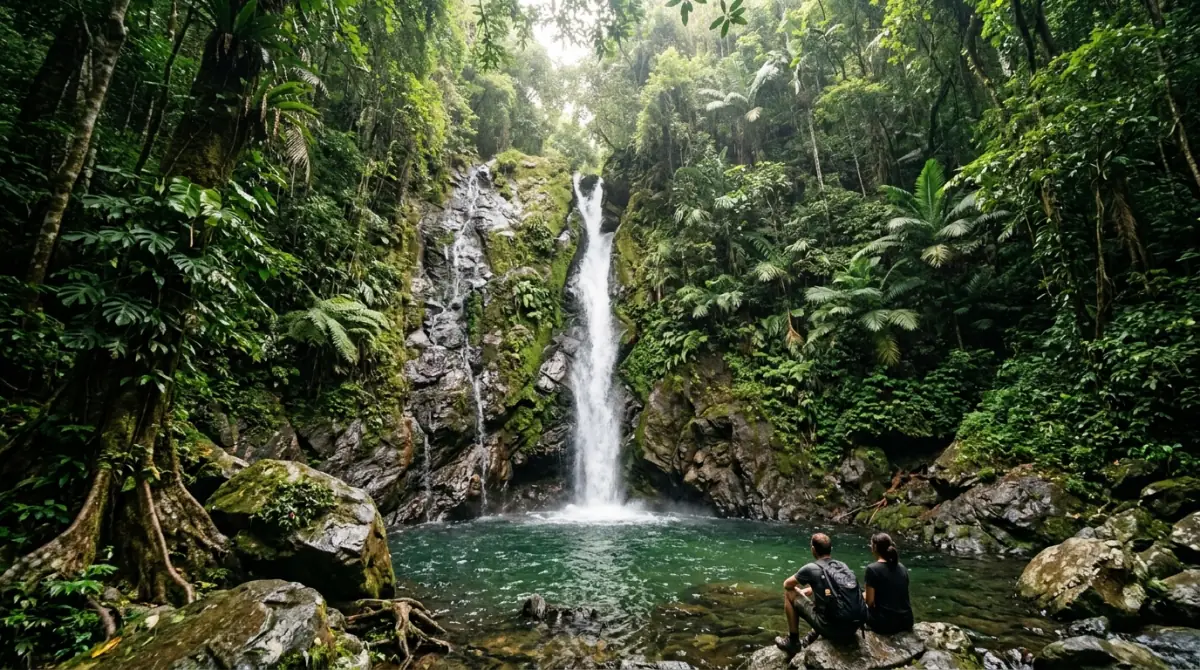
Klong Plu is the one waterfall most visitors should do: 200 THB (about USD 6), a 15-minute walk, a pool you can swim in. The same ticket covers Than Mayom on the same day. Every other fall on the island is free. No elephant venue on Koh Chang is observation-only — every camp still sells rides.
At a glance
| National park ticket (foreign visitors) | 200 THB adult, 100 THB child aged 3–14 |
| Same ticket, Thai nationals | 40 THB adult, 20 THB child — posted policy, not a haggle |
| What the ticket covers | Klong Plu and Than Mayom, same day, keep the stub — check Than Mayom is open before you drive over |
| Waterfalls that charge nothing | Khlong Nonsi, Kheeri Phet, Klong Neung, Kai Bae, Klong Jao Leuam |
| Klong Plu walk from the car park | 600 m, 15–20 minutes, concrete steps |
| Opening hours | Klong Plu open by 08:30, gone by 16:00; Than Mayom disputed, do not count on entry before 09:00 |
| Most water | October to December |
| Thinnest flow | February to April |
| Guided jungle trek | About 900 THB per person for a half day, 1,850–2,150 THB for the Khao Laem summit day |
| Highest point on the island | Khao Salak Phet, about 740 m |
| Share of the island inside the national park | Roughly 75% |
| Elephant camps operating | Four are named below as of April 2026; other listings count five or six — all of them offer riding |
Klong Plu is the waterfall to do, and the month decides how good it is
Klong Plu (also written Khlong Phlu) sits inland from Klong Prao on the west coast, which puts it within a short ride of where most people are staying. The walk in is 600 metres on a maintained trail with concrete steps, 15 to 20 minutes at a normal pace, and it is manageable in trainers. The drop is around 30 metres into a wide plunge pool that you are allowed to swim in, and people jump from the rocks at the edge. There are smaller pools downstream and fish in the shallows.
That accessibility is also the problem. Klong Plu is the island's most visited waterfall and it takes the full weight of the organised tours. Arrive when it opens and you may have the pool to yourself for half an hour. Arrive at 11:00 in high season and you are queuing to photograph the same rock as three minibus groups.
The published opening time is where sources split: some give 08:00, one gives 08:30, and closing is variously 16:30 or 17:00. Treat it as "open by 08:30, gone by 16:00" and the discrepancy stops mattering.
On flow: Klong Plu is the most reliable fall on the island, but reliable is not the same as impressive. From February onwards the whole island's water tables drop and by March and April Klong Plu can be a thin curtain over a large rock face with a pool at the bottom. It is still a pleasant swim and a pleasant walk. It is not the photograph you saw. October to December is when it actually runs, and the rains that fill it are set out month by month in Koh Chang by season.
A canopy walkway was added here at one point and is now closed, so do not plan a visit around it.
Than Mayom is a modest fall, worth an afternoon because the Klong Plu ticket already covers it
Than Mayom is on the east coast a few kilometres past Dan Mai, at the national park headquarters. It is an ordinary waterfall and the drive over is longer than the walk in; the reason to go is that your Klong Plu ticket already covers it. Two things to settle before you commit half a day to it.
The first is whether it is open. A Trat provincial announcement referenced a temporary closure of Than Mayom waterfall and its campground for restoration work. No dates were retrievable and there is no way to tell from any published source whether that closure is still in force, so ring the Mu Ko Chang National Park office on 039 510 928 before you drive across. A Thai speaker helps; a hotel desk will make the call for you if you ask at breakfast.
The second is the gate time. Opening hours are given as 08:00 to 17:00 by the island guides and 09:00 to 16:30 by the national parks site. The two do not agree and neither has been checked against a posted board, so do not plan on being through the gate before 09:00.
The fee is the same 200 THB for foreign visitors — except that it is not, if you have already paid at Klong Plu that day. One ticket covers both falls within the same day. Keep the stub in your pocket and show it at the gate.
Klong Plu in the morning and Than Mayom in the afternoon is one fee and one day; doing them on separate days is two fees for no gain. Treat it as a stop on a day you were already spending on the east coast, not a reason to build one.
The falls run to four tiers. Public access is to the lower section, where a wide path and a concrete walkway lead to a plunge pool you can swim in after crossing the river. The upper tiers are more dramatic and need a guide.
Than Mayom is roughly a 40-minute drive from the west coast beaches, an estimate from the road distance rather than a measured time.
A curiosity rather than a reason to make the drive: two Thai kings visited and had their royal initials cut into boulders along the river, at different points on the climb. Which two is where the local sources disagree — one long-running island guide names Rama V and Rama VII, another names Rama V and Rama VI. Rama V is common to both accounts and is the one you can rely on.
The five free waterfalls are detours from where you already are, not destinations
Everything other than Klong Plu and Than Mayom is outside the ticketed area. Some ask a small voluntary donation, roughly 10 to 40 THB, to the landowner whose access track you use.
Khlong Nonsi, at Dan Mai on the east coast just past the hospital, is the one to combine with Than Mayom. A concrete road runs to the river, then it is about 10 to 15 minutes on foot to the second level, where a concrete dam has made a pool deep enough to swim in. Two marked routes lead up, and the upper levels need reasonable fitness and include one slippery section with a guide rope. Verdict: worth it if you are already on the east coast for Than Mayom, and not worth crossing the island for on its own.
Kheeri Phet (also Khiri Phet) near Salak Phet in the south-east is the best of the free ones for anyone with children. The walk is about 10 minutes on a flat path through a rubber plantation and there are three pools you can get into. Verdict: worth it, but only as part of a day already committed to the south-east, which is a long way from the west coast beaches — see which beach is right for you for why almost nobody is over there.
Klong Neung, also near Salak Phet, is the island's tallest fall and has the smallest pool. Getting to it means 20 to 30 minutes scrambling up a riverbed over fallen trees and boulders, with a water crossing. It is the least visited fall on the island and the one furthest from help. Verdict: skip it unless you are fit, experienced and with a guide, and skip it outright in the rainy season.
Kai Bae waterfall is 15 to 30 minutes from the main street behind Kai Bae beach, on a path described in one source as about 30 cm wide, with a deep pool at the bottom. The sources disagree on whether it is free or 40 THB, so carry a small note. The same source that quotes the fee warns that snakes including king cobra are regularly seen on this path and advises tapping rocks as you go. Verdict: fine if you are staying at Kai Bae and want an hour's walk; not a destination.
Klong Jao Leuam at Klong Son in the north-west is 4 km inland and needs your own transport. Four levels, most people stop at the fourth and largest pool, and there is no mobile signal. Verdict: the quietest of them, and the one you should not do alone.
The viewpoints are roadside stops, and the hour matters more than the spot
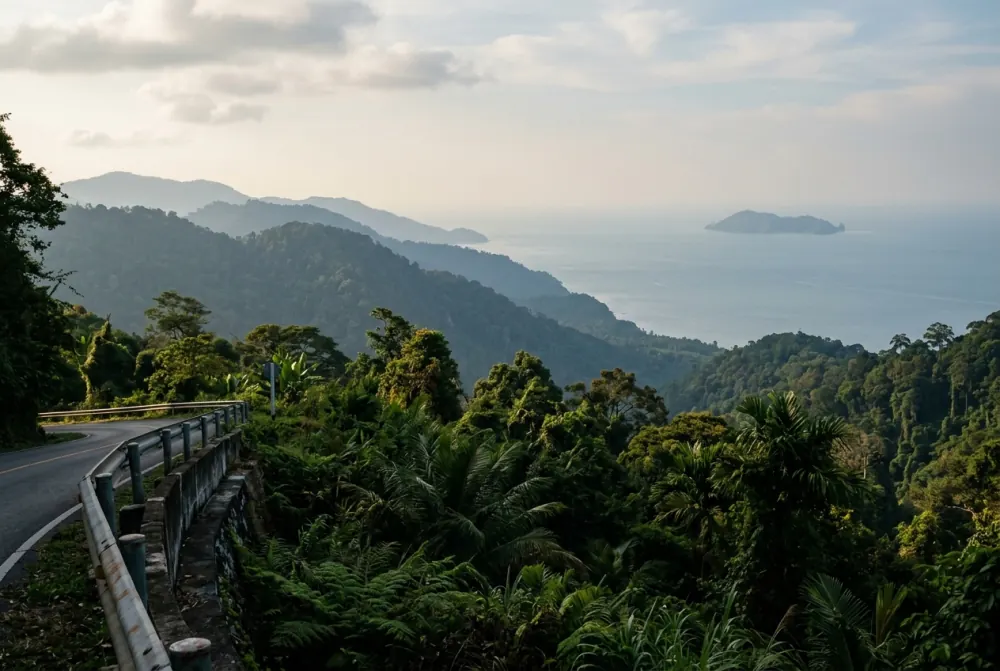
Koh Chang has no road across the interior. What gets called the mountain road is the coast road climbing over headlands, and it has two steep hill sections with hairpins — see getting around Koh Chang for where they are and what they mean on a scooter. Stopping on either one for a photograph means finding an actual pull-off, not the verge on a blind bend.
Kai Bae viewpoint is the one worth planning around. It sits on the main road as it climbs south out of Kai Bae, just past where the bypass rejoins, and looks west over the offshore islets and down the coast. There is a coffee shop, View Cafe, with tables angled at the view. It faces west, so this is a late-afternoon and sunset stop and a poor one at midday. Whether the cafe expects an order for the view is not something the sources state, but buying a coffee costs less than the argument.
The White Buddha above Salak Phet bay is the east-coast counterpart, at Baan Rong Thian between Koh Chang Marina and Salakphet Seafood. There is no entrance fee. A steep concrete road leads to a parking area with toilets, then stairs to a second-level platform and metal ladders to the top. It looks east and south over Salak Phet bay, which makes it a morning viewpoint. It is a Buddhist site and the request is no shorts and no vest tops. The 29-metre statue was still under construction as of mid-2025, with the framework up, so expect scaffolding rather than a finished figure.
On timing generally: in the wet months the clear air is early and the cloud builds through the afternoon, so a morning viewpoint often beats a sunset one. In the dry months from February the reverse applies and afternoon haze is the limiting factor. Neither viewpoint is a summit — the actual high ground on Koh Chang is reached on foot, with a guide, and takes most of a day.
If you want the east-coast falls, the White Buddha and a west-coast beach in one day without a scooter, a car and driver for the day is the only practical way to do it. No local source publishes a west-coast day rate, so agree the figure in baht with the driver before you set off — getting around Koh Chang has what is and is not published on island charters.
The interior is trackless, so trek with a guide or not at all
About three quarters of Koh Chang is national park rainforest rising to Khao Salak Phet at roughly 740 metres. There is no waymarked trail network in it, no signage, no huts and no mobile signal. The ridges look close from the beach because the island is small, but the ground between them is steep and wet, and one stretch of jungle looks much like the next, so a route you thought you were retracing is easy to lose.
The case against going alone is practical rather than moral. If you turn an ankle two hours in on the Khao Jom route, nobody is coming past. Local guides do not publish route descriptions for people to follow independently, and the guided treks all set a minimum of two people for the same reason.
The guides currently working, with what they run:
- Toon — Jungle Fever / Koh Chang Trekking, based at Pearl Beach. Half-day interior treks including a swim in the Klong Prao river, around 900 THB (about USD 27) per person, minimum two people, private options available. He also runs early-morning birdwatching walks from about 07:00, typically Wednesdays and Sundays, at a similar price, and has published a free Android bird identification app with call recordings.
- Pisit — Koh Chang Adventure. Half and full-day treks from around 1,000 THB per person, including the Khao Laem mountain in the south-east. Booking is via Facebook.
- Thomas Koch — customisable private days combining village walks, kayaking and mountain treks. The Khao Laem day is quoted at 2,150 THB (about USD 65) per person for a private group of two or three, or 1,850 THB per person at four or more.
Tan, the guide most older guidebooks and blog posts name, retired in 2025. If a listing or a hotel desk offers you "Tan's trek", ask who is actually leading it.
The routes worth knowing by name: the Klong Son trek over Khao Chedi at around 500 m is five to six hours and includes a waterfall swim; Khao Jom at around 630 m above White Sand Beach is seven to eight hours and the hardest of the standard day treks; the Salak Phet circuit to the Khao Laem summit is eight hours or more and looks out over three southern bays. October to April is the season, both for footing and because the migratory birds are in.
Practicalities that come up every time: wear trainers or light hiking shoes with socks, not sandals. Wear dull colours. Leeches are normal in the wet months, which is why guides carry tobacco. Packages usually include transfer, a packed lunch, water, fruit and repellent. Most operators will not take children under about 14 on the longer routes.
What you will realistically see. The park has around 110 recorded bird species. The ones you have a genuine chance of seeing or hearing are great hornbills, white-bellied sea eagles, kingfishers and sunbirds; hornbills announce themselves by wingbeat long before you see them. Mammals are harder: crab-eating macaques are common enough to turn up at the roadside, the Indochinese lutung is present but shy, and wild boar and palm civets are mostly nocturnal and mostly tracks rather than animals. Monitor lizards are the reptile you will actually see, often near water and often large. Snakes are present, including king cobra and the Cardamom pit viper, and the sensible response is to make noise and look where you put your hands rather than to avoid the forest. A day trek that produces two hornbills, a monitor lizard and a troop of macaques has been a good day. Anyone promising more than that is selling.
No elephant venue on Koh Chang meets the bar, so the recommendation is to skip it here
This site's position across all of these guides is the same: observation only. No riding, no bathing or washing sessions, no shows, no photo props, no baby elephants.
On Koh Chang, no operator currently meets that standard. Four camps are named in current listings as of April 2026 — Klong Son Elephant Camp in the Klong Son valley, Kai Bae Meechai behind the southern end of Kai Bae, Ban Kon Chang in the Klong Plu waterfall area, and Ban Camp Chang at the southern end of Klong Prao. Other listings put the number at five or six, so treat those four as the ones that can be named rather than a closed list, and ask at your hotel desk what is actually trading this month. Every one of the four sells trekking with the visitor in a chair on the elephant's back, typically packaged with a bathing session: around 500 THB (about USD 15) for a one-hour visit with a 45-minute ride, around 900 THB for two hours including swimming with the elephant. One camp also sells evening beach swimming with baby elephants. The island's own long-running activity guide states plainly that these are not sanctuaries, and a 2024 independent investigation reported metal riding chairs, feeding and bathing sessions, trick performances, animals chained beside main roads and stereotypic swaying.
Separately, there are roadside operations in Klong Prao — one opposite Annika Resort — where a tethered elephant is fed and photographed for about 50 THB a basket of fruit. It involves no riding, which is why it looks like the softer option. The animals are still tied up and still working a queue all day. It is not a welfare-led programme and it is not the exception.
Two recent events are worth knowing. In August 2025 Boon Lott's Elephant Sanctuary in Sukhothai removed two elephants from a camp in Klong Prao after more than two million baht was raised online to buy them out. In April 2025 a bull elephant escaped from the Kai Bae camp, injuring people and damaging property.
Questions to ask before you book anywhere, on this island or elsewhere:
- Can I ride? If yes, you have your answer and the rest of the questions are decoration.
- Do visitors bathe, wash or swim with the elephants? A bathing programme means the same animal is handled by group after group all day.
- Are the elephants chained or tethered between sessions, and for how many hours a day?
- How many hours does each elephant work, and how many visitors does each one see in a day?
- Where did each elephant come from, how long has it been here, and who owns it?
- How much space do they have, can they forage, and can they socialise with each other unsupervised?
- Is there a vet, and can you name them?
- Can I simply watch from a distance and not touch anything?
Red flags on arrival, in rough order of how much they tell you:
- Riding chairs or saddles stacked near the entrance.
- A bullhook — a stick with a metal hook — in a mahout's hand or tucked into a belt.
- Elephants swaying or bobbing rhythmically on the spot. That is a confinement behaviour, not contentment.
- Chains short enough that the animal cannot take a few steps, or concrete standing areas.
- Babies used for photographs, beach swims or performances, or a calf kept apart from its mother.
- Scheduled shows: painting, football, standing on things.
- The words sanctuary, rescue or ethical in the marketing while riding is still on the price list.
- Slots running back to back all day with a queue of minibuses.
- No shade, no water, no forage in sight.
If seeing elephants properly matters to you, do it somewhere else on your trip rather than compromising here. The projects usually cited as observation-led are ChangChill and Elephant Nature Park in Chiang Mai and Following Giants on Koh Lanta — none of them near Koh Chang, all of them a separate leg of a trip, and all of them worth putting the same questions to before you book.
One thing that surprises people: Koh Chang has no wild elephant population. The name refers to the island's shape, not its fauna. Every elephant you will see here is a working animal in a camp.
Frequently asked questions
Is Klong Plu waterfall worth it?
Yes between October and December, when it is running properly and the 200 THB ticket buys a real swim. In February to April it thins to a trickle over the rock face and you are paying mainly for a pleasant 15-minute walk and a cool pool. Go at opening time in any month — by mid-morning in high season the tour groups have arrived.
Do you have to pay twice to see both Klong Plu and Than Mayom?
No, as long as you do both on the same day. The 200 THB national park ticket covers both waterfalls within one day. Keep the stub and show it at the second gate. The falls are on opposite coasts, roughly 40 minutes apart by road on an estimate rather than a measured drive, so pairing them is a full day rather than a quick add-on. Check first that Than Mayom is open: a provincial announcement referenced a restoration closure and nothing published says whether it has been lifted, so ring the park office — the number is in the Than Mayom section above, and a hotel desk will make the call for you — before you build a morning around it.
Can you hike on Koh Chang without a guide?
You can walk the short waterfall paths alone — Klong Plu, Khlong Nonsi, Kheeri Phet. Do not attempt the interior routes independently. There are no waymarked trails, no signage and no mobile signal in the forest, and the standard treks all require a minimum of two people for that reason. A guided half day runs around 900 THB per person.
Are there elephants on Koh Chang?
There are captive elephants at the four camps current listings name — other listings count five or six — and no wild population, the island being named for its shape. Every one of them sells rides, usually packaged with a bathing session, and none operates on observation-only terms. If you want to see elephants without riding or handling them, plan it elsewhere in Thailand rather than here.
When do Koh Chang's waterfalls have the most water?
October to December, when every fall on the island is running. From February onwards the smaller falls dry up and Klong Plu becomes the only dependable one. At the peak of the rains the steeper falls in the south-east, Klong Neung especially, become hazardous rather than impressive.
Where is the best sunset viewpoint on Koh Chang?
Kai Bae viewpoint, on the road climbing south out of Kai Bae. It faces west over the offshore islets and has a cafe with tables pointed at the view, which makes it a late-afternoon stop and a dull one at midday. For mornings, the White Buddha above Salak Phet bay on the east coast looks the other way and costs nothing.
Keep reading
- Reaching the island in the first place is the part that decides your arrival day — see transfers to the mainland ferry pier.
Last updated: 2026-08-29. Ferry and pier notes come from Smile Taxi Service drivers running Bangkok-Trat transfers.